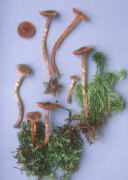
Cortinarius flexipes (Pers. Ex Fr.) Fr. Syn. paleaceus Fr. subgenus Telamonia Bleicher Wasserkopf Pelargonium Webcap Cap 1–3cm across, conical then expanded and umbonate, dark brown when moist, especially at the centre, drying pale fawn, covered in minute white fibrous scales. Stem 30–70 x 2–6mm, brownish, covered at first with the white cottony veil which forms a distinct but short-lived ring and cottony scales below. Gills dark brown often with violet tinge. Flesh pallid. Smell of pelargonium. Gills pallid at first later cinnamon. Spore print rust. Spores broadly elliptic, 6.5–9 x 4–6µ. Habitat damp places on deciduous heathland. Season autumn. Uncommon. Edibility Suspect – avoid as many Cortinarius contain toxins. Found In Europe and America.
Note. Three names have been often used for this fungus, the other two being C. Paleaceus and C. paleiferus. The differences are somewhat subjective, the name C. paleiferus is normally applied to the form with stronger purple tones on cap and stem. The work done by Swedish mycologists has meant that most mycologist now accept C. flexipes as the correct name. |